
Appearance
File and Test Set Settings
Updating File/Test Set Settings
Selecting an item in the Repositories Tree View displays its details in the File / Test Set Settings panel on the right side of the screen, where you can update its settings.
File Settings
When you select a file or folder in the tree view, you can rename it. Feature files must use the .feature extension, and step definition files must use the .step extension.

Test Set Settings
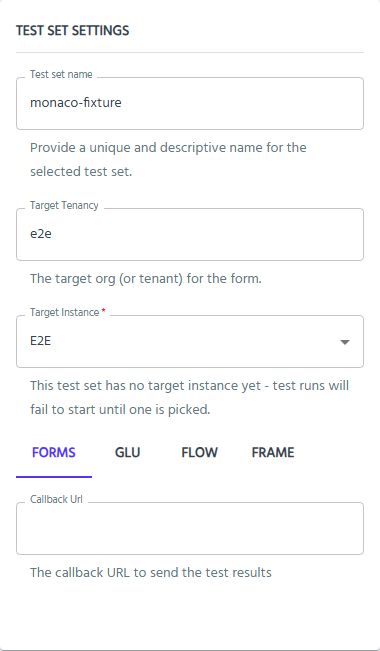
General Settings
- Test set name
A unique, descriptive name for this Test Set. - Target Tenancy
The organisation or tenant code the test set runs against (theTargetOrgkey inConfiguration.json). - Target Instance
The friendly name of the install-configured environment this Test Set runs against (e.g.Prod,Core,Stag). This single choice determines which real AireForms/AireFrame/AireVault/AireGlu/AireFlow URLs your tests hit — you no longer type any of those URLs individually. A Test Set with no Target Instance selected, or one that names an instance your AireAssert install hasn't configured, will fail to start.
FORMS Tab
| Field | Config Key | Description |
|---|---|---|
| Callback Url | CallbackUrl | Optional webhook endpoint to receive real-time test results. |
The AireForms server is resolved from the Target Instance selected in General Settings, and the organisation is set as Target Tenancy there too.
AIREGLU Tab
Configure your AireGlu integration — these settings map to the AireGlu section in your Configuration.json. You can provide:
- Tenancy
The AireGlu Runtime and API URLs are resolved from the Target Instance selected in General Settings, not typed here.
AIREFLOW Tab
Configure your AireFlow integration — these values populate the AireFlow section in your Configuration.json. You can specify:
- Tenancy
The AireFlow Runtime URL is resolved from the Target Instance selected in General Settings, not typed here.
AIREFRAME Tab
Configure the AireFrame users your tests log in as, and how long subject assertions are retried for. These values populate the AireFrame section of your Configuration.json, except for passwords and TOTP secrets, which are stored in AireVault rather than in your repository.
See AireFrame Settings for the full details, including reading a user's TOTP secret from a screenshot of AireFrame's 2FA setup QR code.
Note: After saving your changes, you can verify your integrations by using the Test Connection button on the AIREGLU and AIREFLOW tabs to ensure both connections are working correctly.
After updating any settings, click Save Changes at the bottom of the Test Editor panel. You will be prompted for a commit message.